

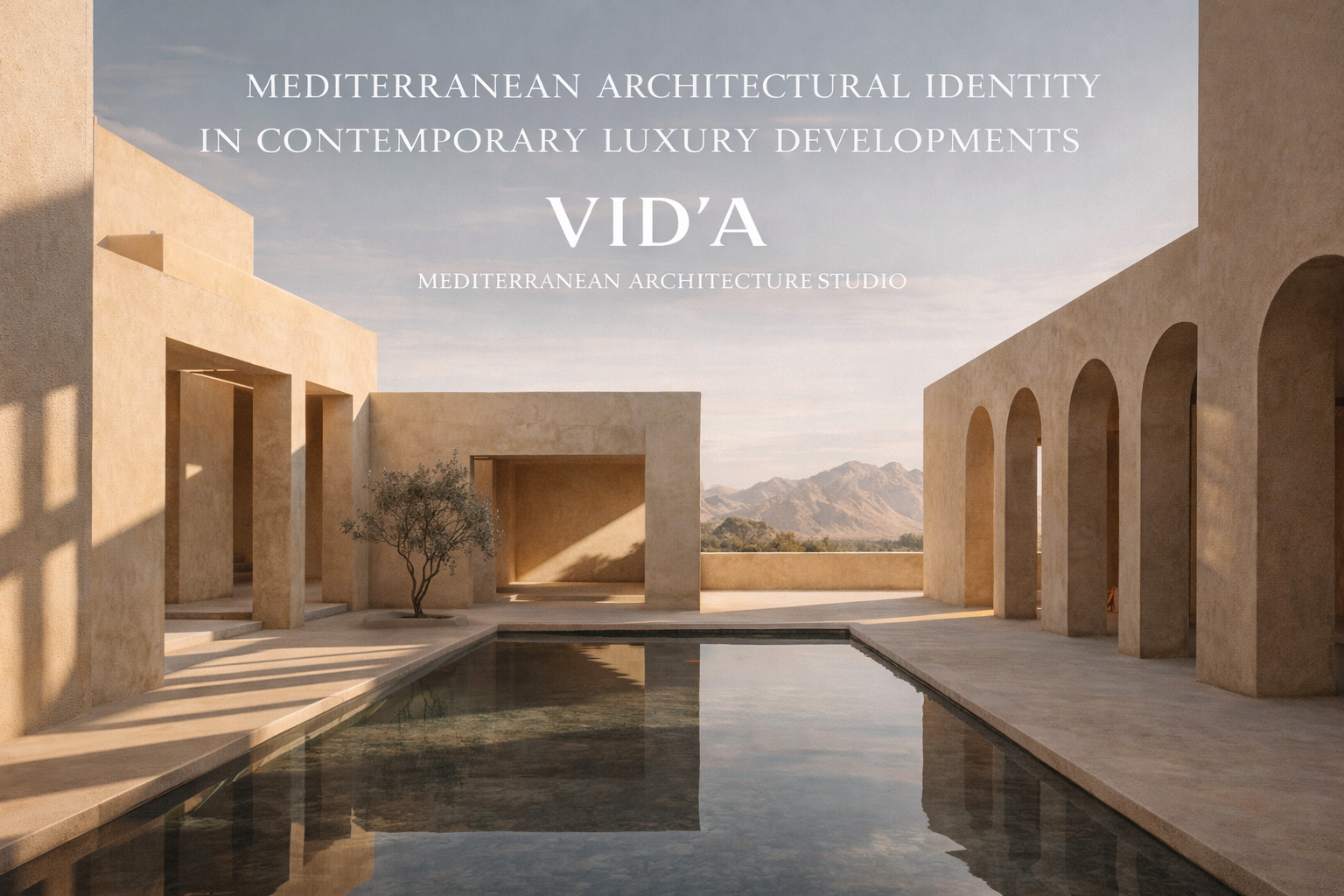
In an era of globalized architecture, luxury developments across emerging markets increasingly risk becoming visually indistinguishable. Glass façades, neutral palettes, and standardized spatial layouts dominate skylines from coastal resorts to rapidly expanding metropolitan districts. Yet in high-end hospitality and residential real estate, differentiation is no longer a stylistic choice — it is a strategic necessity. Investors and developers operating in competitive markets are no longer asking only how to build bigger or taller. They are asking how to build identity — how to create environments that feel rooted, memorable, and culturally resonant rather than interchangeable. Mediterranean architectural principles offer a powerful framework for this shift.
Rather than exporting a decorative style, Mediterranean architecture proposes a spatial logic — one shaped by climate intelligence, material authenticity, and a refined balance between monumentality and human scale.
The Risk of Architectural Homogenization
Across many fast-growing regions, rapid development cycles often prioritize efficiency and visual impact. While this produces striking skylines, it can also generate repetition.
In hospitality, repetition reduces experiential value.
In residential real estate, repetition weakens brand positioning.
In long-term investments, repetition risks commodification.
Distinctiveness today is not achieved through spectacle alone, but through atmosphere, spatial sequencing, and contextual coherence.
Architecture must communicate identity before it communicates luxury.
Climate-Responsive Intelligence
Mediterranean architecture evolved in warm climates defined by intense sunlight, seasonal winds, and the necessity of thermal moderation.
Key principles include:
-
Courtyard-centered spatial organization
-
Layered transitions between interior and exterior
-
Shaded loggias and arcades
-
Thick walls and thermal mass
-
Strategic light modulation
These strategies are not aesthetic gestures. They are environmental responses refined over centuries.
In contemporary luxury developments, these principles can be reinterpreted through advanced materials and engineering systems — transforming sustainability from marketing language into lived spatial experience.
Warm-climate regions undergoing rapid hospitality and residential growth can particularly benefit from this integrated approach.
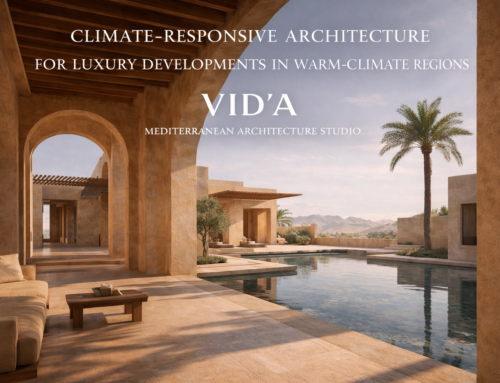
A more detailed exploration of environmental strategy at architectural scale is presented in Climate-Responsive Architecture for Luxury Developments in Warm-Climate Regions where passive design principles are examined in the context of high-end hospitality and residential projects.
Human-Scale Luxury
While monumental architecture can define a skyline, human-scale architecture defines memory.
Mediterranean spatial hierarchy emphasizes progression: arrival, compression, expansion, enclosure, release.
Rather than exposing everything at once, it constructs experience through sequence. Courtyards reveal themselves gradually. Terraces frame controlled vistas. Openings filter light instead of overwhelming it.
In boutique hospitality and high-end residential projects, this spatial choreography generates emotional depth — an increasingly valuable asset in competitive markets.
Luxury becomes experiential rather than purely material.
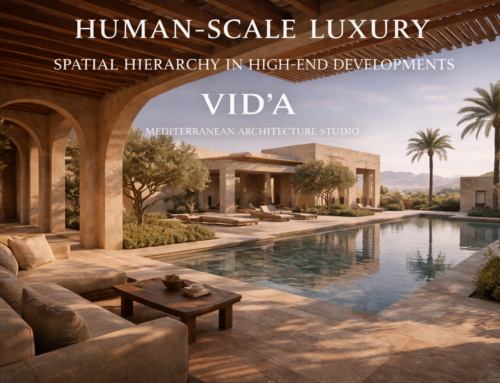
We further develop this perspective in Human-Scale Luxury: Spatial Hierarchy in High-End Developments focusing on spatial progression, proportion, and the role of hierarchy in contemporary luxury environments.
Cultural Adaptability in Emerging Markets
Mediterranean architectural logic is not geographically limited. It is structurally adaptable.
Its emphasis on privacy, inward-facing courtyards, shaded transitional zones, and layered thresholds resonates with cultural contexts where climate and social patterns favor protected outdoor spaces and graduated privacy.
In regions experiencing rapid tourism expansion and diversification strategies — including parts of the Gulf and other warm-climate markets — identity-driven development is becoming a differentiating factor.
The future of hospitality and residential design in these regions may not lie in replicating international glass typologies, but in cultivating climate-conscious, culturally responsive environments with strong narrative coherence.
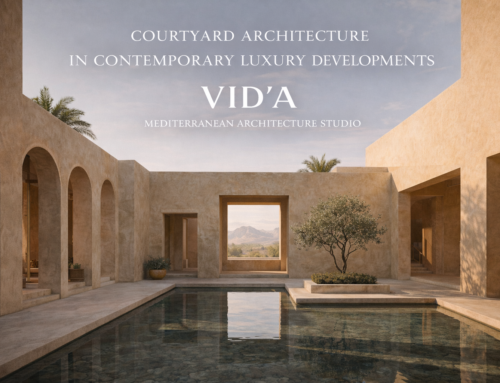
The courtyard typology plays a central role in this adaptability, as explored in Courtyard Architecture in Contemporary Luxury Developments, which examines how inward-facing spatial systems enhance privacy, environmental performance, and experiential depth.
From Concept to Pre-Development Strategy
Architectural identity must be embedded from the earliest stages of development.
Early-phase collaboration can include:
-
Conceptual masterplan frameworks
-
Spatial identity studies
-
Climate-responsive layout strategies
-
Boutique hospitality positioning
-
High-end residential concept development
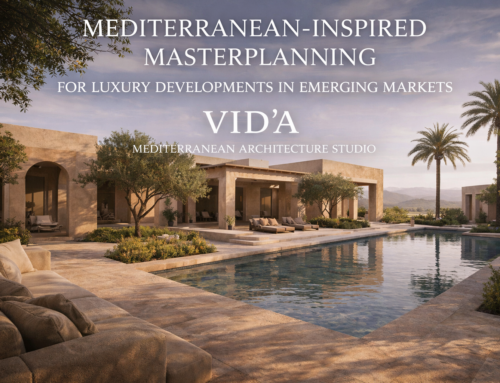
At urban and large-scale level, these principles expand into structured planning systems, as discussed in Mediterranean-Inspired Masterplanning for Luxury Developments in Emerging Markets, where identity becomes embedded within long-term development frameworks.
By integrating architectural narrative, environmental intelligence, and spatial hierarchy from the outset, projects gain coherence — both aesthetically and commercially.
Architecture becomes not just a built object, but a strategic asset.
Toward Distinctive Global Developments
The next generation of luxury developments will not be defined solely by scale or visual impact.
They will be defined by atmosphere, identity, and environmental intelligence.
Mediterranean architectural principles offer a refined and adaptable framework for developers seeking distinction rather than repetition — particularly in warm-climate regions where spatial comfort, shade, material tactility, and human proportion transform investment into experience.
In an increasingly standardized global market, architectural identity is no longer optional.
It is competitive advantage.
Selective International Collaboration
We collaborate with developers and investment groups during early-stage concept development and pre-feasibility phases, particularly for hospitality and high-end residential projects in warm-climate regions.
Our role focuses on architectural identity, spatial strategy, and climate-responsive frameworks that position projects distinctly within competitive markets.
For partnership inquiries, our team is available for preliminary discussions.